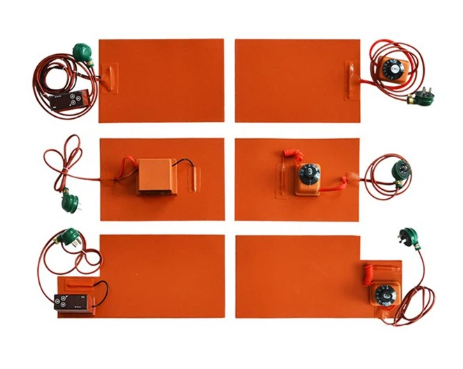
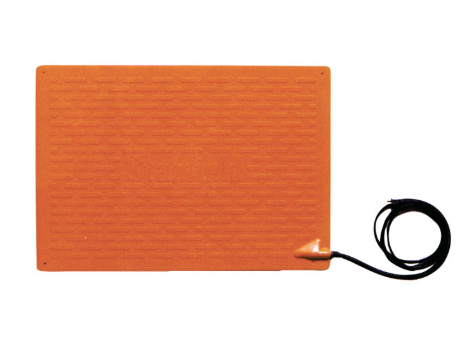
A silicone heating pad is a thin and flexible heater designed to deliver stable and even heat across metal plates, cylinders, battery packs, tanks, instruments, and many other surfaces. It combines etched-foil heating technology with high-grade silicone rubber, offering fast warm-up, long service life, and excellent electrical insulation.
Engineers, builders, and equipment designers choose silicone heating pads because they work well in cold environments, tight areas, and places where traditional heaters cannot fit.
Our silicone heating pads are manufactured with high-temperature silicone rubber, a uniform heating layer, and reinforced fiberglass material. This gives the pad strong flexibility and stable thermal performance, even during long-term use.
Key advantages include:
Whether you need heating for machinery, battery protection, laboratory tools, or seasonal equipment, our silicone heating pad provides a strong and stable solution.
A silicone heating pad serves many fields because of its versatility. It supports both consumer-level and industrial-grade heating tasks. Its typical application including:
Silicone heating pads support steady and uniform heat without large energy losses, making them ideal for daily, technical, and industrial scenarios.
| Specification | Details |
| Material | High-temperature silicone rubber + fiberglass reinforcement |
| Heating Element | Etched-foil or wire-wound |
| Thickness | 1.0–1.6 mm (custom available) |
| Temperature Range | Up to 200–230°C |
| Voltage Options | 12V / 24V / 110V / 220V |
| Watt Density | 0.3–1.0 W/cm² depending on use |
| Back Adhesive | 3M high-temp PSA / silicone glue |
| Temperature Sensors | Thermistor, thermostat, RTD, thermal fuse |
| Protection | Overheat protection optional |
If your application needs special requirements—harsh weather, vacuum, high vibration, or tight temperature control—we can supply enhanced structures.
A silicone heating pad generates heat when electrical current flows through the internal etched-foil heater. This resistance heat spreads through the silicone rubber and warms the surface it touches.
Because silicone rubber has strong thermal stability and full contact with the surface, the heat spreads evenly. This keeps temperatures stable and reduces the risk of hot spots that could damage equipment.
Selecting the proper pad depends on:
A simple guideline:
| Application | Recommended Voltage | Typical Watt Density |
| Small electronics | 12V–24V | 0.3–0.4 W/cm² |
| Battery warmers | 12V–24V | 0.3–0.5 W/cm² |
| 3D printer beds | 24V–110V | 0.4–0.6 W/cm² |
| Industrial machinery | 110V–220V | 0.5–1.0 W/cm² |
If you need help calculating watt density, temperature rise, or surface compatibility, our engineering team can provide guidance.
Temperature control improves safety and performance. We offer several options:
For battery or electronics applications, a PID controller with feedback sensor gives the best stability.
Installing a silicone heating pad is easy:
Before applying the pad, make sure the surface is clean and dry. Avoid sharp bending around the wire leads.
Silicone heating pads are safe when used correctly. Please follow these simple practices:
With proper use, a silicone heating pad delivers long, stable service for both indoor and outdoor environments.
We provide complete customization:
If your project needs a unique heater, we can support rapid prototyping and batch production.
Whether you need a ready-made silicone heating pad or a custom model for your equipment, we can help. Tell us your surface size, voltage, and target temperature, and our engineers will design a heater that fits your product or system perfectly.
📩 Contact us right now for a quote or technical support.
From concept design to mass production. Reliable supply chain, stable quality.
CONTACT USResponse within 12 hours | NDA available | Prototype support

Simply drop your email or phone number in the contact form, and we'll promptly reply you shortly.